Showing posts with label film. Show all posts

Thursday, April 26, 2012

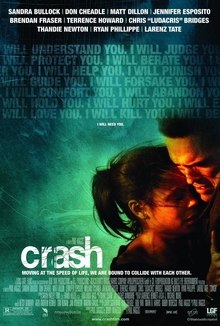
Crash Movie Review

"It's the sense of touch. In any real city, you walk, you know? You brush past people, people bump into you. In L.A., nobody touches you. We're always behind this metal and glass. I think we miss that touch so much, that we crash into each other, just so we can feel something." With these words, Don Cheadle's character Graham Waters opens Crash. When I first heard about Crash, I didn't expect it to be about race and perception. I thought it was a movie about cars! But after watching, I realized that the issues contained in the film are more real than I ever thought them to be before.


1. I think the director's message is simple: there is racism and prejudice hidden in the most unexpected of places. Unfortunately, though our world is continually becoming more global and diverse, there are individuals who are resistant to the harmony that our world hopes to achieve. Through exposing how race seems to be such a sensitive issue, and how people often aren't what they seem, I think the director really wanted to emphasize how sometimes we bring these issues to light, just so we can feel human. Just so we can understand that everyone has similar needs, wants and feelings, no matter what we look like.

2. I think that the movie has depictions of minorities that promote the message of the movie. There are very obvious instances of stereotypes that exist within the film, including Sandra Bullock's character, the white, racist woman, as well as the two African American men who are depicted as "tough" and steal a car, the Persian man who is angry, and the white gun shop owner who distrusts him. Several other depictions feel earnest, including Don Cheadle's character Graham Waters and his partner, Ria. The whole movie is organized around individuals applying stereotypes towards others. To support the director's intended message, that we are all interwoven without even realizing it, and we often "crash" into people we don't expect to, I think the minorities were situational.

3. I think the director's professional and educational background played a role in directing Crash. Since this film has kind of a subtle message, and presents it in an artistic way. Paul Haggis was very influenced by the films of Alfred Hitchcock and Jean-Luc Godard, both notorious for creating iconic, striking films. I think that Crash falls into a similar category. It is memorable, and deals with serious issues in a dynamic, yet subtle way.

4. I would hope that individuals watching this film would understand its message of inter-woven lives, and not be offended by the medium and characters used to convey it. However, I think that African Americans, people from the Middle East, and Asian people might be offended, because some of their minority groups are depicted stereotypically and thus negatively.

5. The movie added to my visual literacy by challenging my perceptive powers. Since so many of the characters' lives intersect throughout the film, (and there are a lot of characters, whose stories all have something to add to each other), I had to continually update my idea of each character, when I gained new information about them. I think we can use this type of perceptive update in our everyday lives, by reminding ourselves that no matter who a person is, we never know when their life might "crash" into our own.

6. Like Jean-Luc Godard and Alfred Hitchcock, Paul Haggis employs subtle visual means to convey the message of how people's separate lives "crash" into each other sometimes. By the recurrence of characters encountering one another, and different events causing "domino effects," this causes viewers to have to recall their initial perceptions of characters and compare them to how said characters are represented throughout the film.

Monday, February 27, 2012

AHA-The Oscars!

Photo-Flickr: Loren Javier
This might be a stretch for a Visual Literacy blog topic, but really think that the Oscars are a big part of our country's visual culture. Though the Internet has certainly changed the face of mass communication in today's society, television and film still play significant roles in people's lives. One of the most celebrated awards in film is the Oscar, and every year the Academy Awards are televised so that America can see who and what wins each award. I would have to think that these awards and the films that essentially compete to receive them are part of our visual literacy. Since the Academy Awards are advertised and broadcast on a prime-time network during prime viewing hours (last night it was 7e/4p), one would assume that the general public finds them to be important. 37.6 million people tuned in to watch the Oscars, and it would have been 37.6 million plus one more if I hadn't had to work last night.

I think that the best film, in terms of visual literacy, this year has to have been The Artist, directed by Michael Hazanavicius. The Artist is a silent film, about a silent film star, George Valentin, who is anxious as to whether or not talking films will put him out of a job. The movie is in black and white, which keeps the focus on the action taking place on the screen. The lack of verbal communication places more emphasis on the visual elements of the film.


If you watch the trailer above, you will notice that the actors are primarily communicating with such dynamic personal visuals as facial expressions, dramatic gestures, and body language, relying completely on nonverbal communication to carry the action. The only verbal communication that occurs comes at the very end of the film. I highly recommend seeing The Artist if you haven't, it's a real treat!

Mary McNamara, a Los Angeles Times Television critic, noted that as the Oscars reoccur every year, numbers are waning. And though the Oscars have become predictable to an extent (the same process happens every year, hosts dramatically opening envelopes, famous people winning awards, giving short speeches, hosts cracking jokes in the mean time), we still love it. Maybe it's the anticipation of seeing the fashion on the red carpet, or the banter between this year's hosts, or the excitement of finding out each winning nominee. For me, it's the chance to catch a glimpse of movies I've missed for the year, to appreciate which actors and actresses have been hard at work to bring imaginative new films to life, and my favorite, seeing which film wins best cinematography! This year, it was Hugo, directed by Martin Scorsese, cinematography Robert Richardson.
Cinemastyles.blogspot.com

I love the Oscars. I try to watch them every year, because I really do think that they encompass the spirit of film. Of course, I might be biased. I am a pretty huge film devotee, and I am a loyal viewer of Turner Classic Movie's 31 days of Oscar.

See all of the nominees and winners of the Oscars 2012 here.