Showing posts with label communication. Show all posts

Sunday, April 29, 2012

Visual Literacy in My Life-Today

http://tinyurl.com/6r836pr
On the first day of Visual Literacy class, Magda talked about "making the invisible visible." Coming into VL, I thought we would be learning about art, about using visuals in the classroom and not really delving into perception and aesthetics as much as we did. I also didn't think of how impactful a lot of the activities would be, or how the movies would make me go AHA! But now, thinking back over the course of our class's experience this semester, I realize that I have learned a lot. Much of the "invisble" has become visible to me.

Aristotelian Aesthetics
I have learned to challenge my judgments, to look past face value and to consider how an object fits into the grander "scheme of things." Everything and everyone in our world is connected (something I learned from Crash), and we have to think about how the way we choose to represent ourselves, and our ideas, may affect others and our world. I also came to understand my own perception, and how perception is SO prominent in the media, advertising and in communication in general. Everyone has their own schema, and each individual's perception determines how he or she interprets a visual. When designing visuals, it is important to consider how the way you choose to represent something might affect different people. I got really interested into perceptual aesthetics during the course of our class, and I will use this new knowledge in my future classroom. Aesthetics is a very puzzling category of philosophy and visual studies, and I am very interested in learning more about this field, especially Aristotelian Aesthetic theory.

The movies and our class discussion was another favorite part of Visual Literacy this semester. Everyone in the class had a different perspective to offer when considering issues and visual theories that we encountered. Now when I watch commercials, I always think of Jean Kilbourn's Killing Us Softly, and I am shocked at how many ads contain subtle messages within the visual choices they make. Thinking about this fact, I wonder how I represent myself with my actions and body language. Non-verbal language, and visuals, say so much MORE than words. You know that phrase "actions speak louder than words,"? Well, it is incredibly true, and now more than ever I am tuned into the way visuals communicate in our society.

I had a great time in Visual Literacy this semester, and I will be able to use my knowledge in my future classroom. I just designed a teaching unit focused on Chaucer's The Canterbury Tales. I included an activity that was exclusively about using the visual communicative power of woodcuts in conveying a story. Students have to view different pictures, without seeing the accompanying words, and determine what is happening in the plot. There are lots of resources available out there for connecting medieval literature with art. Thanks to visual literacy, I know I will be more prepared to help students "make the invisible visible," and find deeper meaning from their classroom activities. I want them to look twice, at everything they encounter. Maybe they'll become a famous artist or filmmaker someday, and they can say, "my high school English teacher challenged me to do this." I would be so proud :)


Thursday, April 26, 2012

Crash Movie Review

"It's the sense of touch. In any real city, you walk, you know? You brush past people, people bump into you. In L.A., nobody touches you. We're always behind this metal and glass. I think we miss that touch so much, that we crash into each other, just so we can feel something." With these words, Don Cheadle's character Graham Waters opens Crash. When I first heard about Crash, I didn't expect it to be about race and perception. I thought it was a movie about cars! But after watching, I realized that the issues contained in the film are more real than I ever thought them to be before.


1. I think the director's message is simple: there is racism and prejudice hidden in the most unexpected of places. Unfortunately, though our world is continually becoming more global and diverse, there are individuals who are resistant to the harmony that our world hopes to achieve. Through exposing how race seems to be such a sensitive issue, and how people often aren't what they seem, I think the director really wanted to emphasize how sometimes we bring these issues to light, just so we can feel human. Just so we can understand that everyone has similar needs, wants and feelings, no matter what we look like.

2. I think that the movie has depictions of minorities that promote the message of the movie. There are very obvious instances of stereotypes that exist within the film, including Sandra Bullock's character, the white, racist woman, as well as the two African American men who are depicted as "tough" and steal a car, the Persian man who is angry, and the white gun shop owner who distrusts him. Several other depictions feel earnest, including Don Cheadle's character Graham Waters and his partner, Ria. The whole movie is organized around individuals applying stereotypes towards others. To support the director's intended message, that we are all interwoven without even realizing it, and we often "crash" into people we don't expect to, I think the minorities were situational.

3. I think the director's professional and educational background played a role in directing Crash. Since this film has kind of a subtle message, and presents it in an artistic way. Paul Haggis was very influenced by the films of Alfred Hitchcock and Jean-Luc Godard, both notorious for creating iconic, striking films. I think that Crash falls into a similar category. It is memorable, and deals with serious issues in a dynamic, yet subtle way.

4. I would hope that individuals watching this film would understand its message of inter-woven lives, and not be offended by the medium and characters used to convey it. However, I think that African Americans, people from the Middle East, and Asian people might be offended, because some of their minority groups are depicted stereotypically and thus negatively.

5. The movie added to my visual literacy by challenging my perceptive powers. Since so many of the characters' lives intersect throughout the film, (and there are a lot of characters, whose stories all have something to add to each other), I had to continually update my idea of each character, when I gained new information about them. I think we can use this type of perceptive update in our everyday lives, by reminding ourselves that no matter who a person is, we never know when their life might "crash" into our own.

6. Like Jean-Luc Godard and Alfred Hitchcock, Paul Haggis employs subtle visual means to convey the message of how people's separate lives "crash" into each other sometimes. By the recurrence of characters encountering one another, and different events causing "domino effects," this causes viewers to have to recall their initial perceptions of characters and compare them to how said characters are represented throughout the film.

Monday, April 2, 2012

AHA! Life on the Screen: George Lucas on Education

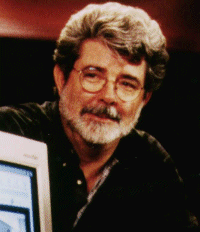
George Lucas
For those of us who are loyal Star Wars fans, George Lucas may be seen as near and dear to our hearts. Even if you aren't into Star Wars, Indiana Jones or American Graffiti, George Lucas is still a notable filmmaker within the realm of cinema. In the Edutopia article "Life on the Screen; Visual Literacy in Education," written by James Daly, Lucas comments on his thoughts about America's changing literacy skills. As a man who is considered to have a creative mind and who values the changing mediums with which we communicate today (film, television, web), Lucas offers his take on what the American education system needs to do to connect better with students, and encourage more visual literacy and communication skills, skills that are more applicable to our current world and students' lives.

George Lucas explains that he was "an average student who daydreamed  a lot," a description that might describe many of the students in our education system today. Perhaps it wasn't that Lucas was uninterested in the things he was being taught, rather, he was uninterested in the way in which such things were taught. This memory of his past has inspired Lucas to promote a new way of learning that emphasizes students' need to succeed in a visual, digital world. Today's students are used to a faster-paced society, and so they are more interested in learning things when they are made more relevant to the things they know. "They need to understand a new language of expression," says Lucas, which means that students want to  be taught in such a way that they are using today's tools, rather than antiquated styles of learning.

Wordle of Media
Mr. Lucas thinks there is a lot of change on the horizon. Today, the language of visual literacy has become more prominent and necessary, because or society has created a visual culture that needs to be learned about in order to be perpetuated and utilized effectively. We have so much contained within the visual culture that to not teach about and expose students to an understanding of visual literacy would be extremely unwise. Lucas remarks "We must teach communication comprehensively, in all its forms. Today we work with the written or spoken word as the primary form of communication. But we also need to understand the importance of graphics, music, and cinema, which are just as powerful and in some ways more deeply intertwined with young people's culture. We live and work in a visually sophisticated world, so we must be sophisticated in using all the forms of communication, not just the written word." I think Lucas really hits the nail on the head (to use a silly cliche) when he comments upon how we need to teach communication in relation to visual literacy. You see so many people who want to make effective presentations and get their points across effectively, in school and business settings, and often times they are very clueless in terms of what an effective presentation (using visual elements) must contain.

In terms of the future, I think that we need to take Lucas's words to heart, and really reconsider how we're approaching the development of our visual literacy, both inside the classroom and out. Do we learn more about visual literacy from our daily lives? For now I think we do, but that may be subject to change in the coming years. If Lucas's hopes are fulfilled, we're going to have to start trying harder. "Nothing is accomplished through conquest. Everything is accomplished through education," (George Lucas, 2004).

Sunday, February 26, 2012

SIGNS: Sometimes Speech Is Unnecessary

I was looking through our Visual Literacy schedule today, wondering (like any responsible student) what was coming due, when I noticed a link on last week's activities called "Signs." At first, I thought it was something related to the presentation that my friend and fellow classmate Lauren and I had given on February 20 for Visual Verbal Relationships. But, it wasn't. It was a Youtube video that Magda had evidently placed in the schedule to support the topics of that week. So, from the video's title, I assumed that it would be all about pictorial signs, using picture symbols to show meaning and establish communication between different parties. However, I was surprised to find that my assumption was quite wrong. Directed by Patrick Hughes, "Signs" was a sweet, unexpected short film. The focus was not on pictorial signs in place of words, but actual signs with words written on them, read by the main character Jason, and the woman he meets named Stacey. Like one of the comments on the Youtube video said, they told a more beautiful love story than Twilight did in 90 minutes!


I think that we often over-simplify communication, and we under-think about it. To an average American, at least those that I've encountered, we take words for granted. We don't realize what an affect/effect they can have on those around us, or individuals in particular. In the video, Jason is going about his hum-drum day without anything to interest or motivate him. That is, until Stacey throws herself into his life with her simple sign "Take a photo." To Jason, this sentenced might have seemed sardonic and abrasive, something that we would expect from a person who might want to be left alone. Yet, when Jason's face indicated that he was flustered and troubled by her first comment (as a result of not hearing vocal tone or inflection), Stacey followed with another sign, "I'm kidding!" Then Jason was able to understand that Stacey was interested in a conversation, which was confirmed by Stacey showing a written sign of her name. After the conversation was initiated, it continued with both Jason and Stacey communicating with one another only by written signs through windows across buildings. Though the words that these two exchanged were on a very simple level, they contained a lot of meaning because of the intentions of the parties involved.

Think about how many times we text without even thinking about how what we say could possibly be misconstrued! Now think about how even though words are valuable tools, how simply we can communicate when we need to. My friend Colin and I were watching the German film "M" from director Fritz Lang earlier today, and Colin commented that he could usually understand children's German more easily than adults. I said that it was probably because of the simplified language and increased non-verbals that children utilized, because to an extent they're still learning and getting a hang of the language. Sometimes speech is not even necessary; when you want to deeply communicate something, and you can't think of words, signs (like faces, gestures, motions and body language) save the day.

Can you think of any instances where non-verbalized communication actually serves a more useful purpose than verbal communication? Have you ever been in a situation where you couldn't think of the right words to say, until someone else said something first? Do you think that Stacey and Jason actually grew closer because they had to "meet" in this fashion?


Tuesday, October 11, 2011

A Fresh Start in a New World with Flat Classroom

Earlier, I watched the keynote of the first Flat Classroom Project installment of 2010, by Judy O'Connell from St. Joseph's College in Hunter's Hill, Australia. In her video, Judy mentioned the popular film, "Avatar" and how it can be seen as a kind of metaphor for the Flat Classroom Project. In the film, Jake Sulley is given the opportunity for "a fresh start," on "a new world." "You'll be making a difference," he is told, and these words are his invitation to travel to Pandora on his mission. All Jake must do is say yes, and accept his mission. As we come to see in the film, it is not an easy one, but Jake comes to learn about, participate in, and eventually understand a different culture and group of people different from himself. He learns, however, that he and the people of Pandora, are not so different after all.

Like Jake Sulley, participants in the Flat Classroom Project are given an opportunity to participate in a new world. "The Flat Classroom Project is your Pandora, a fresh start in global learning, it's your opportunity to be world-class students, develop your world-view, demonstrate to all of use the importance of good scholarship and good digital learning." O'Connell is spot on in her analogy, in that the power of the Flat Classroom lies in students' opportunities to expand their perspectives in our world, and see beyond the walls of their physical classroom. Instead of limited interaction with students within our physical community, Flat Classroom makes meeting, communicating, and collaborating with students across the globe, a reality. Children are highly adept at using online applications, Web 2.0 tools such as social media, search engines, as well as other tools supporting creativity. Therefore, they have the perfect set of provisions to support their learning in an online, global environment.

The Internet provides an optimal platform for global education to occur because it "levels the playing field" for individuals anywhere. Using multiple means of creativity and sharing, from text, audio, video, hypertext, and other multimedia, we can show our thoughts and ideas, and give feedback to others, with just the click of a mouse. And because our students today are so used to (and good at) this high level of media creation and manipulation, it is becoming more prominent in classrooms, both traditional and online. Check out this video created by Michael Wesch (in collaboration with 200 students at Kansas State University!) about how today's students feel about changing the face of learning and the traditional "classroom."


The Flat Classroom Project supports both digital literacy skills and learning, as well as global collaboration between classrooms across the planet. In the Flat Classroom, cultural understanding becomes personal, for each student, because he or she is interacting with students from cultures outside their own. What better way to learn about another culture than to speak and work with individuals from diverse backgrounds? The result is that students become less ethnocentric, and more globally aware. By learning about other areas of the globe, we also learn about ourselves. They also work on their skills with Web 2.0 tools, as well as tools essential or online learning and communication. There may come a day where our classrooms, however we define them now, may look a lot different, in that there may be no more "classrooms" but students will host their own learning networks, through online collaboration and communication.

I am starting to look at my own classroom experiences differently. I am starting to think "I wonder what it would be like if everyone in my classes, including myself, became more globally aware?" Would we see each other differently? Would we see what we read about, write about, and learn about in the same way? Will my future students have a better sense of global relevancy, and how will this affect the lessons I teach and the literature I choose to share? As a future English teacher, I am focused on how my students will read and write in the classroom, sure. But now I'm starting to think, how will my students read, write, and SHARE? And where will this lead them?